> For the complete documentation index, see [llms.txt](https://docs.motivewave.com/llms.txt). Markdown versions of documentation pages are available by appending `.md` to page URLs; this page is available as [Markdown](https://docs.motivewave.com/user-guide/console-1/docking-framework-guide/pages.md).
# Pages
Pages provide a convenient way to manage a virtually unlimited number of panels (charts, watch lists, gauges etc) in different layouts. The page bar at the bottom of the Console window is initially configured with several preset pages. Left click on a page tab to show the layout in the content section of the window. In the default layout you will see the following pages:
* **Home** – Contains a sample home layout with a chart section and two watch list sections on the bottom.
* **Charts** – Sample chart layout with six charts (2 rows, 3 columns)
* **Floating** – This station allows overlap, resizing and can be moved freely while maintaining the fix location and sizing.
* **Account** – Account related panels including Accounts, Orders, Positions and Trade History
* **Trade Report** – Useful for analyzing your trading performance
* **Options** – Contains Groups of Options ( Stock and Future Options)
* **Scan** – Sample layout for running a scanner and viewing the results in a chart
* **Optimize** – Simple layout with the Back Test/Optimize panel.
The screen shot below shows the page bar (at the bottom of the console window) and highlights some of the features.
## Adding a Page
Click on the New Page Button (**+** button to the right of the last page tab). This will show the New Page dialog:
The New Page dialog requires a name for the page (displayed in the tab) and a layout. Layouts are arranged in categories:
* **Chart** – Typical chart layouts. Some include watch lists and or account/order/position/trades panels.
* **Account** – Some account management layouts. Layouts include account, order, position, trades and watch lists panels.
* Options – Layouts for Option Chains.
* **Scan** – Layouts for performing scans (on Studies, Elliott Waves or Harmonic patterns).
* **Optimize** – Layouts for optimizing/back testing strategies
* **Floating** – Layout for floating stations.
An icon is displayed on the left side of the tab to indicate the category of the layout. The screen shot below shows the new page added to the page bar (and active).
## Edit a Page
Click on the **Edit Page** button (right side of the page bar) or go to the **Configure** menu and click on the **Layout** option to change the name and/or layout of the active page:
The screen shot below shows the changes made to the page.
## Copy Page
In some cases, it may be convenient to copy an existing page instead of creating a new one. When a page is copied the existing layout is copied including all of the stations and panels.
Click on the Copy Page button on the right side of the page bar.
The screen shot below shows the copied page added to the page bar:
## Re-order Pages
Page tabs can be re-ordered by clicking/dragging a tab to the desired location. As you drag the tab a vertical blue bar will appear that indicates where the tab will be placed.
## Overflow Tabs
There is no limit to the number of page tabs you can have. If there is not enough space to display the tabs, an overflow button will appear with the number of unseen tabs in the label.
## Import/Export Pages
One or multiple pages can be exported to .zip files and be imported into another desktop ( See [Desktop](/user-guide/console-1/desktops.md) for more information) or another workspace.
### Export Pages
To export a page, right click on that page ( usually located at the bottom Pages bar) and select **Export Pages** or go to the **File** menu then select **Export Pages** :
The Export Pages dialog will open. You can then assign a location to save the exported file by selecting the Browse button or simply click on the directory section. Click on the plus (+) icon to add the pages. If a Floating page is selected, you can select which floating stations to export by clicking on the pencil icon.
Add Page Dialog
### Import Pages
To import pages into another desktop or workspace, simply select File > Import Pages from the top console or right click on a page at the bottom Pages bar and select the .zip file.
If there are already existing pages on the workspace/console, you will have options to change the name of the page or skip the page.
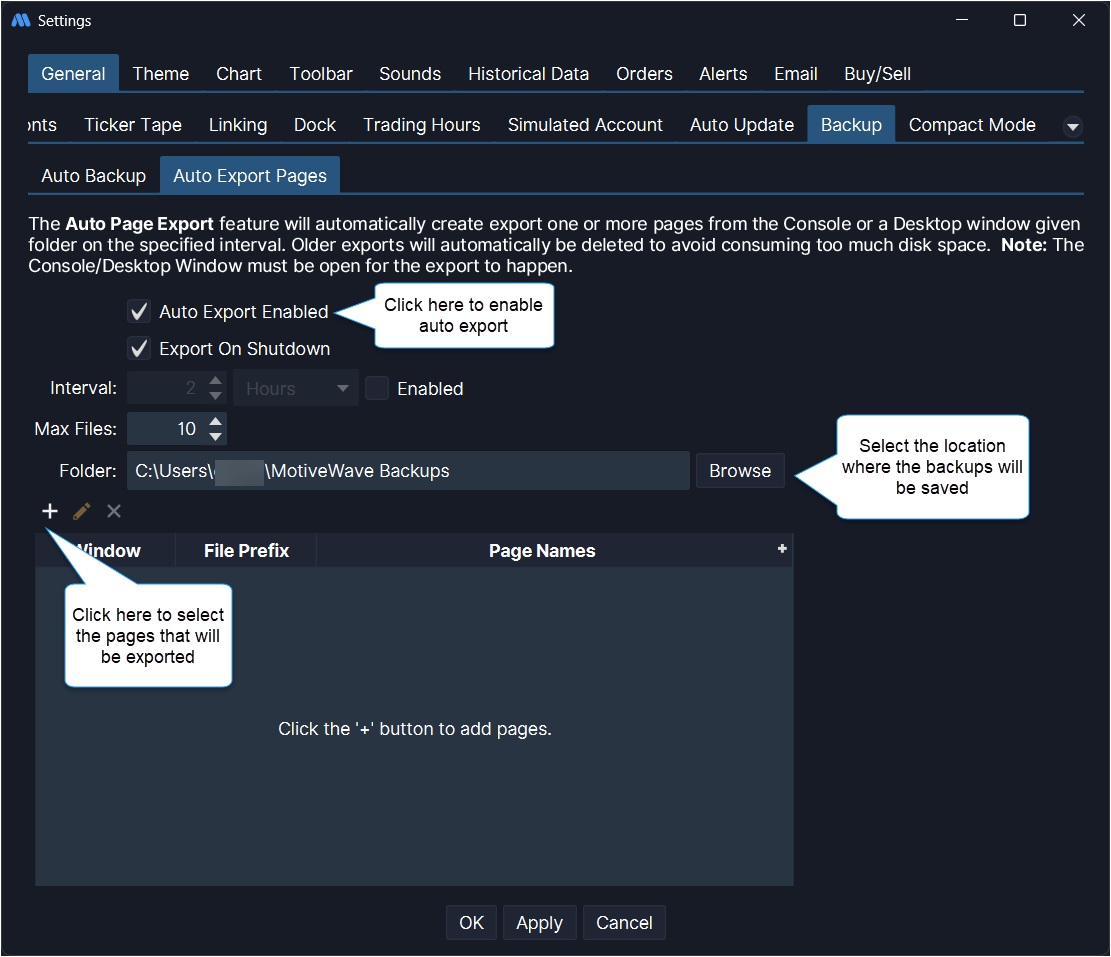
### Auto Export Pages
Pages can be automatically exported for your convenience, this can be done via the Configure menu > Settings > General > Backup > Auto Export Pages